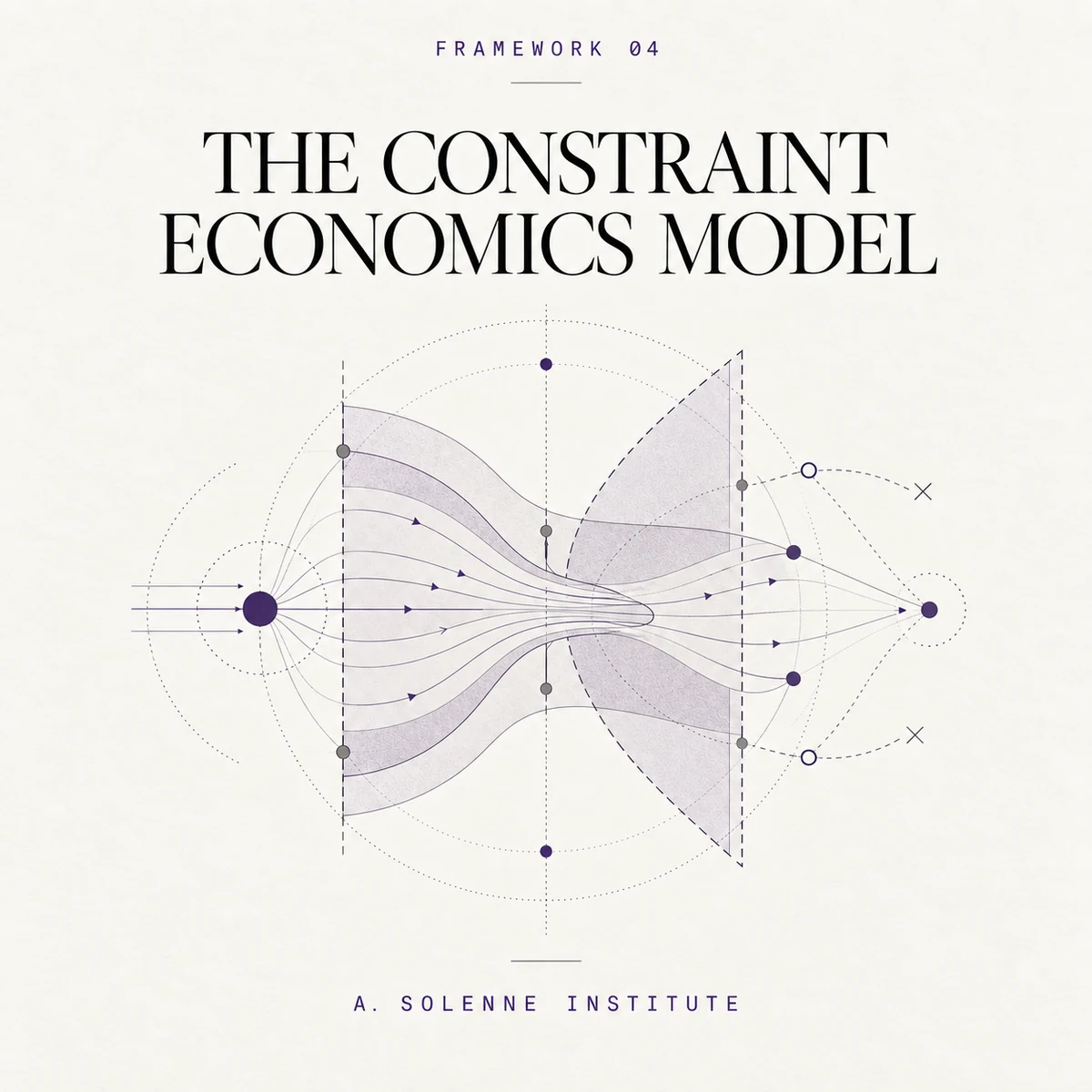
The Constraint Economics Model
Price range: $555.00 through $2,500.00
A behavioral-economics model for examining how incentives, scarcity, loss aversion, opportunity cost, and financial identity shape the allocation of money, time, attention, cognitive capacity, and relational investment.
Description
Domain: Economic Behavior, Incentive Systems, and Financial Psychology
Behavior follows incentive structure. What a person does reveals the economy they are actually operating in.
Human action often follows perceived incentive structures more reliably than stated values. The Constraint Economics Model examines how rewards, penalties, loss aversion, opportunity costs, and status incentives exert pressure on behavior, including when a person is consciously committed to a different outcome.
The model applies behavioral economics and financial psychology to the allocation of scarce resources: money, time, attention, cognitive capacity, and relational investment. It also examines how identity, perceived scarcity, access to resources, and beliefs about wealth shape economic behavior. Financial psychology is treated as part of identity and regulatory architecture rather than as a separate domain.
What this framework examines
- Economic Incentive Structures: How rewards, penalties, and social incentives shape behavior regardless of stated intention.
- Capital Allocation: The psychological drivers behind the distribution of finite resources across competing demands.
- Opportunity Cost Recognition: The capacity to perceive and properly weight foregone alternatives.
- Financial Psychology: How identity, scarcity, and loss aversion shape a person’s relationship with wealth and economic behavior.
Research context
The model draws on behavioral economics, prospect theory, loss-aversion research, scarcity and cognitive-bandwidth scholarship, and financial psychology.
Format and licensing
This is a digital A. Solenne Institute framework publication. Select the license that matches the intended use shown on this product. Institutional use is handled through a separate written agreement and inquiry process. The publication is theoretical, conceptual, educational, and informational; it is not therapy, medical or psychiatric advice, legal or financial advice, professional certification, or a guarantee of results.
Additional information
| License | Personal Study, Practitioner, Founder / Operator |
|---|
Related products
-

The Contextual Field Model
Price range: $555.00 through $2,500.00Select options This product has multiple variants. The options may be chosen on the product page -

The Authority Topology Framework
Price range: $1,500.00 through $2,500.00Select options This product has multiple variants. The options may be chosen on the product page -

The Reflective Cognition Model
Price range: $555.00 through $1,500.00Select options This product has multiple variants. The options may be chosen on the product page -

The Decision Field Model
Price range: $555.00 through $2,500.00Select options This product has multiple variants. The options may be chosen on the product page
Reviews
There are no reviews yet.