Human Systems Architecture
The structures and interactions that organize human functioning across psychological, behavioral, environmental, and economic domains.
A. Solenne Institute · Est. 2025
Human behavior is not a character problem. It is a structural one.
An independent research institute developing original frameworks in human systems. The work addresses identity, regulation, decision architecture, and behavior, examined as a single integrated system.
Entry Points
Essay Archive
Publications
Framework Archive
Frameworks
Foundational Model
Human Systems Model
Founding Documents
Doctrine
Institute Research Commentary
Research Notes
A. Solenne Institute
Institute Membership
Inquiry
Access
Essay Archive
Structural essays on human systems, identity architecture, and behavioral analysis. Each essay is a permanent record.
Publication No. 001
Why Human Systems Must Be Understood Structurally
Human behavior is not random. It is the output of interacting systems. Understanding it requires structure, not advice.
Publication No. 002
The Architecture of Identity, Psychology, and Decision
Identity is not who someone believes they are. It is a structured configuration of forces that shapes perception, interpretation, and action.
Publication No. 003
On the Failure of Isolated Intervention
Most attempts at sustained change do not hold. The behavior changes temporarily. The system underneath does not.
Modern culture produces an excess of information about human behavior, yet very little of it is organized in a way that makes behavior understandable or predictable.
Psychology explains patterns of thought. Economics explains decision-making under constraint. Neuroscience explains mechanisms within the brain. Leadership theory addresses influence and action. Each field offers insight into a specific dimension of human behavior, but these insights remain largely isolated.
As a result, individuals are left to interpret fragmented knowledge without a unifying structure. Information accumulates, but understanding does not. Behavior appears inconsistent, not because it is random, but because the systems producing it are not being examined together.
This fragmentation has practical consequences. People attempt to change their behavior using isolated strategies. They apply discipline in one area while remaining reactive in another. They pursue clarity in identity while operating within environments that contradict their intentions. They make decisions that appear irrational, despite having access to information that suggests otherwise.
Without a structural understanding, behavior appears unpredictable when it is simply misunderstood. What is often labeled as inconsistency is more accurately the result of competing systems operating without coordination.
Human behavior is not random. It is the output of interacting systems.
These systems include, but are not limited to, identity formation, emotional regulation, decision-making processes, environmental conditions, and economic constraints. Each system influences the others. Identity shapes decisions. Emotional states affect perception. Environment constrains available choices. Economic conditions influence long-term strategy.
When these systems are examined in isolation, they appear manageable. When they are understood in relation to one another, their complexity becomes visible. This complexity does not make behavior uncontrollable. It makes it structured.
A structural approach to human behavior does not begin with advice. It begins with architecture. Rather than asking how to change behavior directly, it examines the systems producing that behavior. It identifies how those systems interact, where they conflict, and where they reinforce one another. This approach replaces surface-level intervention with system-level clarity.
Instead of attempting to force consistency, it becomes possible to understand why consistency fails. Instead of relying on motivation, it becomes possible to design conditions that support stable behavior. Instead of interpreting actions as personal shortcomings, they can be recognized as outputs of identifiable structures. Within this framework, change is not imposed. It is engineered.
The purpose of the A. Solenne Institute is to study and organize these systems. Its work is centered on developing interdisciplinary frameworks that map the relationships between identity, emotional regulation, decision-making, and economic behavior. The goal is not to produce commentary, but to construct models that make human behavior more intelligible.
When human systems are understood structurally, several shifts occur. Behavior becomes interpretable rather than confusing. Decisions become strategic rather than reactive. Emotional states become manageable rather than overwhelming. Identity becomes something that can be examined and refined, rather than something that feels fixed or unstable.
This does not simplify human behavior. It clarifies it. Clarity does not eliminate complexity. It makes complexity navigable.
Azari Solenne · Founder and Systems Architect · A. Solenne Institute · © 2026
Modern discussions of identity often treat it as a fixed trait or a personal narrative. Psychology examines behavior through patterns of thought and emotion. Decision-making is frequently framed as a matter of logic or discipline. Each of these perspectives captures part of the picture. None of them, on their own, explain how identity, psychology, and decision-making operate together as a system.
As a result, identity is often misunderstood. It is not simply who someone believes they are. It is a structured configuration of internal and external influences that shape perception, interpretation, and action.
Psychological processes influence how information is processed. Emotional states alter perception and response. Environmental conditions constrain available choices. Economic realities influence long-term strategy. Identity forms at the intersection of these forces.
Decision-making does not occur in isolation. It is influenced by identity, shaped by psychological patterns, and constrained by environment and resources.
What appears to be a poor decision is often the result of a system operating exactly as it is structured. When identity is unstable, decisions become inconsistent. When emotional regulation is weak, perception becomes distorted. When environmental constraints are ignored, strategies fail. These outcomes are not random. They are structural.
A structural understanding of identity requires moving beyond narrative. It requires examining how identity is constructed, how it interacts with emotional and cognitive systems, and how it influences decision-making over time. This approach does not attempt to redefine identity through affirmation or belief alone. It examines the systems that produce identity and the conditions that sustain it.
Within this framework, identity becomes something that can be analyzed rather than assumed. Psychology becomes a component within a larger system rather than a complete explanation. Decision-making becomes an output rather than a purely conscious act. This shift allows for greater precision.
Instead of asking why behavior is inconsistent, it becomes possible to identify which system is misaligned. Instead of attempting to correct behavior directly, attention can be directed toward restructuring the systems producing it. Identity is not a fixed point. It is an evolving system. Understanding its architecture allows for more deliberate navigation of behavior, decision-making, and long-term direction.
Azari Solenne · Founder and Systems Architect · A. Solenne Institute · © 2026
The most common approach to changing human behavior is to target the behavior itself. When someone makes poor financial decisions, the solution offered is financial literacy. When someone struggles with emotional regulation, the solution offered is techniques for managing that emotion. When someone cannot maintain discipline, the solution offered is a better system for tracking habits. Each of these interventions addresses the visible symptom. None of them addresses the system producing it.
This is why most attempts at sustained change do not hold. The behavior changes temporarily because the intervention creates pressure at the surface. But the systems underneath remain intact. When the pressure lifts, those systems reassert themselves. The pattern returns, often in the exact form it took before. This is not a failure of willpower. It is a failure of entry point.
Behavior is downstream of system. Targeting behavior without addressing the underlying systems is the equivalent of adjusting the output while leaving the inputs that produce it completely untouched.
Identity shapes what feels possible. Psychology determines what gets processed and how. Environment reinforces patterns before conscious thought has a chance to intervene. Economics defines the range of realistic options. The result will always be temporary.
A structural approach identifies the actual origin of a behavior before attempting to change it. This requires a different set of questions. Not "why can't I be more consistent?" but "what is the system that produces inconsistency?" Not "how do I make better decisions?" but "what are the psychological and environmental conditions shaping the decisions I am already making?" These questions do not feel immediately actionable. That is precisely why they are the correct ones.
Lasting change begins at the level of structure, not behavior. It requires identifying which systems are in conflict, which patterns are being reinforced by the environment, and which beliefs about identity are constraining the available choices. When these are made visible, the behavior is no longer a mystery. It is a logical output of a system that can now be examined and, where necessary, restructured.
The A. Solenne Institute was built on this premise. Its frameworks do not begin with what to do differently. They begin with what is actually producing the current result. This shift in starting point changes everything that follows.
You are not lacking discipline. You are operating within a structure that makes discipline unsustainable. You are not making irrational choices. You are making rational choices within a constrained system that has not been fully examined.
You are not broken. You are unstructured. And structure can be built.
Azari Solenne · Founder and Systems Architect · A. Solenne Institute · © 2026
Sovereign Bureau Registry
Frameworks are admitted to the archive only when structurally complete. Partial models are not published.
Featured Frameworks

Identity Architecture Model
A model explaining how inherited belief systems and self-schemas function as the primary perceptual lens through which all experience is filtered, shaping what outcomes appear possible before any decision is made.

Emotional Governance Framework
A model explaining how emotional regulation and nervous system stability shape behavior and decision-making. Behavioral consistency is not a character trait. It is a nervous system state.

Decision Architecture Framework
A model showing that decisions emerge from an integrated field of forces before deliberation begins. The field of a decision shapes its outcome before any conscious reasoning engages.
Complete Archive
The Perceptual Architecture Model
Identity Formation and Structural Self-Concept
The Regulatory Intelligence Framework
Psychology, Emotional Governance, and Nervous System Stability
The Decision Field Model
Decision Science, Cognitive Architecture, and Choice Behavior
The Constraint Economics Model
Economic Behavior, Incentive Systems, and Financial Psychology
The Authority Topology Framework
Leadership Psychology, Power Perception, and Organizational Influence
The Reflective Cognition Model
Metacognition, Cognitive Awareness, and Belief Revision
The Strategic Focus Framework
Attention Management, Strategic Clarity, and Resource Allocation
The Contextual Field Model
Environmental Psychology, Social Context, and Behavioral Architecture
The Pattern Recognition Framework
Systems Thinking, Feedback Dynamics, and Structural Pattern Identification
The Sovereign Mind Model
Philosophical Self-Governance, Autonomy, and Internal Authority
The Capacity Expansion Model
Cognitive Growth, Neuroplasticity, and Long-Term Human Development
The Temporal Orientation Model
Time Psychology, Future-Self Identity, and Temporal Decision Architecture
The Applied Intelligence Model
Information Processing, Cognitive Translation, and Operational Intelligence
Research Area
Identity Systems
In Research
Research Area
Behavior Systems
In Research
Research Area
Decision Systems
In Research
Research Area
Economic Systems
In Research
Framework 01
Identity Formation and Structural Self-Concept
The self is not a fact. It is a construction. And every construction follows a blueprint.
Identity is not a fixed attribute that individuals possess. It is a dynamic architecture that they build, revise, and inhabit. This framework examines how individuals construct their sense of self through the interaction of inherited belief systems, relational experiences, cultural narratives, and deliberate self-authorship. The resulting identity structure does not merely describe who a person is. It functions as the primary perceptual lens through which all subsequent experience is filtered and interpreted.
Research across cognitive, developmental, and personality psychology confirms that self-schemas, the internal representations individuals hold about their own traits, capacities, and roles, operate as active governors of perception, memory, and ambition. What a person believes about who they are determines which experiences register as relevant, which possibilities appear viable, and what risks feel tolerable. This is not an abstract claim. It is a mechanistic description of how identity functions as infrastructure.
The Perceptual Architecture Model addresses identity formation across all major life transitions, with particular attention to the process of self-authorship: the developmental capacity to construct an internal belief system no longer dependent on external authority. It is within this framework that questions of inherited identity, perceptual constraint, and conscious identity redesign are most rigorously examined.
Core Focus Areas
How early relational and cultural environments establish baseline self-schemas that persist into adulthood.
The developmental progression from externally defined to internally governed identity construction.
The structural disruption and reconsolidation of self-concept during major life and role changes.
How identity architecture narrows or expands the range of outcomes an individual considers possible.
Research Anchors Self-Schema Theory (Markus, 1977); Narrative Identity Framework (McAdams, 1985, 2013); Self-Authorship Theory (Baxter Magolda); Identity Status Paradigm (Marcia, 1966).
A. Solenne Institute · The Sovereign Bureau · © 2026
Framework 02
Psychology, Emotional Governance, and Nervous System Stability
Behavioral consistency is not a character trait. It is a nervous system state.
The capacity to act with intentionality, sustain effort, and maintain behavioral consistency across varying conditions is not fundamentally a function of motivation or discipline. It is a function of the regulatory state of the underlying psychological and physiological system. Emotional governance refers to the sophistication with which an individual manages the internal environment from which behavior emerges: the interplay of nervous system state, emotional arousal, threat response patterns, and the executive capacity to remain deliberate under pressure.
When regulatory systems are dysregulated, whether through chronic stress, unprocessed threat activation, or depleted regulatory resources, access to higher-order cognition narrows. The gap between intention and action widens. What an individual knows they should do and what they actually do diverge not because of a character deficit but because the system producing behavior is not in a state that supports aligned action.
This framework draws extensively from autonomic neuroscience, including Polyvagal Theory and its implications for the relationship between physiological state and psychological capacity. It also addresses emotional discipline as a trainable, architecturally shapeable skill rather than an innate trait. The regulatory system is not fixed. It is responsive. This framework maps the conditions under which it can be deliberately developed.
Core Focus Areas
The cognitive and physiological mechanisms by which individuals modulate emotional states in response to internal and external demands.
The role of nervous system state in determining behavioral range, decision quality, and social engagement capacity.
How habituated patterns of threat response shape behavior across contexts and over time.
The deliberate cultivation of regulatory capacity as a structural skill, distinct from suppression or avoidance.
Research Anchors Polyvagal Theory (Porges, 1994; Frontiers in Behavioral Neuroscience, 2025); Emotion Regulation and Executive Function Research; Autonomic Regulation and Behavioral Flexibility.
A. Solenne Institute · The Sovereign Bureau · © 2026
Framework 03
Decision Science, Cognitive Architecture, and Choice Behavior
The field of a decision shapes its outcome before any deliberation begins.
Decision-making is not a discrete event. It is an emergent output of an integrated system comprising identity assumptions, emotional and physiological state, environmental context, cognitive load, and deeply habituated pattern recognition. Understanding any decision requires mapping the field in which it occurs, not merely examining the moment of apparent choice.
The dual-process literature demonstrates that the vast majority of human decisions originate from fast, automatic, and largely unconscious processes rather than deliberate analytical reasoning. The subjective experience of conscious choice is, in many cases, a post-hoc construction. What appears as an autonomous decision is frequently the surface expression of a system that had already reached a conclusion.
The Decision Field Model examines how individuals construct and inhabit decision environments, how risk perception is shaped by framing and identity, how attention allocation determines which options become visible, and how tradeoff evaluation is systematically distorted by cognitive biases. It provides analytical tools for mapping the full architecture of any decision system.
Core Focus Areas
How risk tolerance is shaped by identity architecture, regulatory state, and framing rather than objective probability.
The structural influence of presentation, context, and language on how choices are evaluated before deliberation.
How the direction and quality of attention determines which decision possibilities are recognized and pursued.
The cognitive and emotional mechanisms underlying how individuals weigh competing options across time horizons.
Research Anchors Kahneman, D. (2011), Thinking, Fast and Slow; Prospect Theory (Kahneman and Tversky, 1979); Dual Process Theory (Stanovich and West); Attentional Engagement and Decision Architecture (Organization Science, 2019).
A. Solenne Institute · The Sovereign Bureau · © 2026
Framework 04
Economic Behavior, Incentive Systems, and Financial Psychology
Behavior follows incentive structure. What a person does reveals the economy they are actually operating in.
Human action does not follow stated values. It follows perceived incentive structures. The gap between what individuals report valuing and what they actually prioritize in behavior is not primarily a gap of character. It is a gap of incentive architecture. Economic and social forces, including financial rewards, loss aversion effects, opportunity cost calculations, and social status incentives, exert systematic and often invisible pressure on behavior even when individuals are consciously committed to different outcomes.
This framework applies the analytical tools of behavioral economics and financial psychology to the study of how individuals allocate scarce resources: not only money, but attention, time, cognitive capacity, and relational investment. Scarcity, whether real or perceived, activates distinct cognitive patterns that distort decision quality in predictable and mappable ways.
The Constraint Economics Model also addresses the psychological relationship individuals hold with wealth, capital, and financial identity. How a person conceptualizes their economic position, their access to resources, and their capacity to generate financial outcomes is not separable from their behavior in those domains. This framework treats financial psychology as an extension of identity and regulatory architecture rather than a separate domain.
Core Focus Areas
How reward systems, penalties, and social incentives shape behavior regardless of stated intentions.
The psychological drivers of how individuals distribute finite resources across competing demands.
The cognitive capacity to perceive and weight foregone alternatives in decision-making.
How identity architecture, scarcity mindset, and loss aversion shape an individual's relationship with wealth and economic behavior.
Research Anchors Prospect Theory and Loss Aversion (Kahneman and Tversky, 1979); Nudge Theory (Thaler and Sunstein, 2008); Scarcity and Cognitive Bandwidth (Mullainathan and Shafir, 2013).
A. Solenne Institute · The Sovereign Bureau · © 2026
Framework 05
Leadership Psychology, Power Perception, and Organizational Influence
Authority is not a position. It is a perception. And perception is governed by architecture.
Authority is not conferred by title or role alone. It is constructed through the dynamic interaction of power perception, behavioral signaling, relational positioning, and the psychological readiness of followers to grant or withdraw legitimacy. This framework examines the full topology of authority as it operates in organizational, interpersonal, and social systems: how it is established, how it is challenged, how it erodes, and how it can be exercised with both structural force and psychological intelligence.
Research on organizational power dynamics demonstrates that authority is a profoundly psychological phenomenon. The same formal position produces radically different behavioral outcomes depending on how it is perceived, what signals accompany it, and the regulatory state of those it attempts to lead. Influence does not simply flow from rank.
This framework gives particular attention to composure under pressure, the perception of competence and certainty, influence through framing rather than force, and the psychology of resistance and compliance. Authority over one's own behavior is examined within this framework as a domain of psychological skill in its own right.
Core Focus Areas
The psychological and physiological conditions that produce the behavioral signals associated with perceived authority.
How individuals evaluate, assign, and revoke legitimacy in organizational and interpersonal contexts.
The structural design of conditions that reliably produce compliance, collaboration, or resistance.
How power dynamics shape communication patterns, decision processes, and institutional culture.
Research Anchors French and Raven (1959), Bases of Social Power; Power Distance Research (Hofstede); Transformational and Transactional Leadership (Bass, 1995); Four Faces of Power in Organizations (Fleming and Spicer, 2014).
A. Solenne Institute · The Sovereign Bureau · © 2026
Framework 06
Metacognition, Cognitive Awareness, and Belief Revision
The quality of thinking is determined by the quality of attention brought to the act of thinking itself.
Metacognition, the capacity to monitor, evaluate, and regulate one's own cognitive processes, is one of the most consequential and least systematically developed capacities in human functioning. Individuals with sophisticated metacognitive ability are able to recognize the operation of cognitive biases, adjust reasoning strategies in response to error, revise beliefs in the presence of contradicting evidence, and sustain deliberate analytical engagement under conditions of complexity and pressure.
This framework examines reflective cognition as a structured domain of psychological skill: one that can be mapped, assessed, and deliberately developed. It draws from cognitive psychology research on metacognitive monitoring and control, dual-process theory's account of when and why System 2 reasoning is engaged or bypassed.
This framework distinguishes between the awareness of one's cognitive state and the capacity to act on that awareness. Knowing that a bias is operating and successfully redirecting the cognitive process are not the same skill. The Reflective Cognition Model addresses both dimensions and the conditions under which they diverge.
Core Focus Areas
The structured identification of systematic errors in perception, reasoning, and judgment.
The ongoing evaluation of one's own reasoning quality, confidence calibration, and epistemic accuracy.
The deliberate examination of belief structures, assumptions, and inferential habits.
The psychological processes and conditions that allow or inhibit the updating of established beliefs in response to new evidence.
Research Anchors Metacognition and Sense of Agency (ScienceDirect, 2023); npj Science of Learning, Metacognition Research (2021); Fleming and Dolan, Metacognitive Ability Research.
A. Solenne Institute · The Sovereign Bureau · © 2026
Framework 07
Attention Management, Strategic Clarity, and Resource Allocation
Strategy is not a plan. It is a discipline of directed attention applied consistently over time.
Strategic capacity does not emerge from the quality of a plan. It emerges from the quality and consistency of attention management over time. Where an individual or system directs cognitive and behavioral resources, what it selects out, what it deprioritizes, and how it sustains focus in the presence of competing demands, determines the quality of strategic outcomes far more reliably than the sophistication of any stated objective.
This framework examines attention as a finite, strategically deployable resource with measurable effects on outcome quality. Research on attentional engagement demonstrates that how individuals frame problems, the cognitive strategies they apply to prioritization, and the degree of sustained focus they bring to consequential activity directly predict strategic effectiveness.
The Strategic Focus Framework provides analytical tools for mapping current attention distribution, identifying misalignments between stated priorities and actual resource allocation, and designing environments that support sustained strategic clarity. It also addresses the psychology of opportunity selection: how identity architecture, risk orientation, and cognitive bias shape which options appear worth pursuing before deliberate analysis begins.
Core Focus Areas
The precision with which an individual identifies high-leverage activities and maintains alignment between values, priorities, and actions.
The psychological and cognitive processes governing which possibilities are recognized and pursued.
The deliberate governance of cognitive focus as a finite and consequential resource.
The structural conditions that support goal persistence, strategic sequencing, and deferred outcome evaluation.
Research Anchors Attention-Based View of the Firm (Ocasio, 1997); Attentional Engagement and Problem-Solving Strategy (Organization Science, 2019); Goal-Setting Theory (Locke and Latham).
A. Solenne Institute · The Sovereign Bureau · © 2026
Framework 08
Interdisciplinary Synthesis and Unified Human Behavior Modeling
The whole person cannot be understood through any single discipline. They must be mapped as a system.
Human functioning cannot be adequately explained within the boundaries of any single academic discipline. Psychology illuminates internal architecture but cannot fully account for economic behavior. Neuroscience maps physiological substrates but does not independently explain social dynamics. Philosophy clarifies assumptions but requires empirical grounding. Economics captures incentive logic but operates on simplified models of motivation. Each discipline offers a partial map. None offers a complete one.
The Integrated Systems Architecture is the meta-framework of the institute: the theoretical structure within which all other frameworks are positioned and related to one another. It provides the interdisciplinary scaffolding for understanding how identity, regulation, decision systems, authority dynamics, environmental influence, and personal capacity interact and reinforce each other across the full range of human experience.
This framework draws from systems theory, the biopsychosocial model, complexity science, and the rapidly expanding field of interdisciplinary behavioral research. It treats the human being not as a set of separable subsystems but as an integrated, self-organizing system whose outputs can only be understood by examining the interactions among its structural components.
Core Focus Areas
The synthesis of psychological, economic, neuroscientific, and philosophical frameworks into a coherent account of human behavior.
How forces operating across multiple domains compound, amplify, or counteract one another within the human system.
The capacity to identify and examine the invisible forces shaping perception, decision, and behavior from the inside.
The development of analytical frameworks that account for the full complexity of human functioning without reductionism.
Research Anchors Biopsychosocial Model (Engel, 1977); Systems Theory Applications in Behavioral Psychology; Complexity Theory in Human Systems (Stacey); General Systems Theory (von Bertalanffy).
A. Solenne Institute · The Sovereign Bureau · © 2026
Framework 09
Environmental Psychology, Social Context, and Behavioral Architecture
Behavior is not independent of context. It is, in large part, produced by it.
The context in which choices are presented exerts measurable and often decisive influence over the choices that are made. Social expectations, cultural narratives, physical environments, institutional structures, and economic conditions all shape how individuals evaluate their options before deliberate reasoning engages. These contextual forces operate continuously, invisibly, and with predictable effects on behavior.
This framework examines the full range of environmental influences on behavior and decision architecture. It provides analytical tools for mapping the contextual forces operating in any given behavioral field: the social norms that govern what appears acceptable, the cultural narratives that determine what appears possible, the economic conditions that shape what appears affordable, and the physical environments that structure what appears convenient.
The Contextual Field Model also addresses choice architecture, the deliberate design of environments to influence behavior without altering available options, as a structural intervention strategy. Understanding environment as a behavioral force rather than a neutral backdrop is a prerequisite for any serious analysis of why individuals behave as they do.
Core Focus Areas
The shared stories, assumptions, and frameworks a culture provides that shape what individuals consider possible or legitimate.
How perceived norms, roles, and relational demands govern behavior through anticipated approval and disapproval.
The structural rewards and costs embedded in physical and social contexts that shape behavior before conscious deliberation.
How the design of choice environments systematically shapes decision outcomes independent of individual preference.
Research Anchors Choice Architecture (Thaler and Sunstein, 2008); Environmental Psychology (Fischer); Social Determinants of Behavior; Behavioral Nudge Theory.
A. Solenne Institute · The Sovereign Bureau · © 2026
Framework 10
Systems Thinking, Feedback Dynamics, and Structural Pattern Identification
A repeated outcome is not a coincidence. It is the system reporting its own design.
Human experience frequently appears unpredictable at the level of individual events. Examined at the level of underlying systems, however, recurring patterns emerge with reliable consistency. Repeated behavioral outcomes, recurring emotional responses, persistent relational dynamics, and cyclical decision patterns are not random. They are structural outputs: the product of identity architecture, regulatory states, environmental conditions, and habituated cognitive processes operating in combination.
This framework provides systematic tools for identifying, analyzing, and intervening in the structural patterns that produce recurring outcomes. It draws from systems theory's account of feedback loops, both reinforcing and balancing, and applies these concepts to the analysis of individual behavior, interpersonal dynamics, and organizational culture.
The Pattern Recognition Framework is particularly relevant to any analysis of why change efforts fail. Most behavioral change interventions operate at the level of individual events or conscious intentions without addressing the structural conditions that generate the pattern being changed. This framework redirects attention to those conditions.
Core Focus Areas
The analytical capacity to identify structural regularities beneath apparently random or isolated behavioral events.
How reinforcing and balancing feedback mechanisms amplify or constrain behavioral patterns over time.
The recurring outcomes produced by stable configurations of identity, regulation, environment, and habit.
The leverage points within a system where targeted change produces disproportionate impact on behavioral patterns.
Research Anchors Systems Thinking and Feedback Dynamics (Senge, The Fifth Discipline); Habit Formation Research (Wood and Neal, 2007); Complexity Theory Applications in Behavioral Science.
A. Solenne Institute · The Sovereign Bureau · © 2026
Framework 11
Philosophical Self-Governance, Autonomy, and Internal Authority
Internal authority is not the absence of external influence. It is the capacity to govern oneself in its presence.
Self-governance is not achieved by eliminating external influence. It is achieved by developing a sufficiently robust internal authority structure that can engage with external forces without being governed by them. This framework examines the philosophical and psychological conditions under which individuals develop genuine autonomy: the capacity to form, sustain, and act from beliefs and values that are authentically their own rather than absorbed uncritically from authority figures, cultural narratives, or social pressure.
The philosophical tradition bearing most directly on this framework extends from Kantian moral autonomy through Nietzsche's account of the sovereign individual as one who has developed a memory of the will sufficient to make and keep commitments independent of external sanction. Contemporary psychological research on self-determination theory and epistemic autonomy grounds these philosophical claims in empirical findings.
The Sovereign Mind Model examines self-trust as a structural capacity rather than a disposition, intellectual independence as a developed skill rather than a personality trait, and decision ownership as a practice that requires both philosophical clarity and regulatory stability to sustain.
Core Focus Areas
The structural and psychological conditions under which individuals develop reliable confidence in their own judgment.
The capacity to form, hold, and revise beliefs on the basis of evidence and reasoning rather than social conformity.
The psychological practice of making and sustaining commitments in full awareness of their costs and consequences.
The philosophical and psychological foundation for governing one's own belief formation independent of external authority.
Research Anchors Self-Determination Theory (Deci and Ryan); Philosophical Models of Personal Autonomy (Essex Autonomy Project, 2012); Stanford Encyclopedia of Philosophy, Autonomy entry.
A. Solenne Institute · The Sovereign Bureau · © 2026
Framework 12
Cognitive Growth, Neuroplasticity, and Long-Term Human Development
Capacity is not fixed at birth or finalized in adolescence. It is a variable that responds to architecture.
The prevalent cultural model of human capacity as a relatively fixed endowment is empirically inaccurate. Cognitive, emotional, and behavioral capacity are dynamic variables that respond throughout adulthood to the conditions individuals create and inhabit. Neuroplasticity research confirms that the brain retains significant adaptive capacity across the lifespan: the ability to reorganize structurally and functionally in response to experience, deliberate practice, and environmental demand.
This framework examines the structural conditions that support or inhibit the expansion of human capacity over time. It draws from cognitive neuroscience research on neuroplasticity, learning systems research on the conditions that produce durable skill acquisition, resilience science on the neurocognitive mechanisms underlying adaptive functioning under adversity.
The Capacity Expansion Model addresses deliberate cognitive renewal as a practice: the structured engagement in activities that challenge existing processing patterns and build new cognitive infrastructure. It also examines the role of regulatory stability as a prerequisite for capacity development and the conditions under which resilience is developed rather than merely hoped for.
Core Focus Areas
The mechanisms by which deliberate experience produces structural and functional changes in cognitive architecture.
The neurocognitive conditions that support adaptive functioning and recovery of capacity under conditions of adversity.
The structural conditions that produce durable skill acquisition, belief revision, and cognitive pattern change.
The sustained developmental practices that expand cognitive, emotional, and strategic range over time.
Research Anchors Neuroplasticity and Behavioral Modification (Preprints.org, 2025); Neuromarkers of Adaptive Neuroplasticity (MDPI, 2026); Neurocognitive Mechanisms of Human Resilience (PMC); Deliberate Practice Research (Ericsson).
A. Solenne Institute · The Sovereign Bureau · © 2026
Framework 13
Time Psychology, Future-Self Identity, and Temporal Decision Architecture
Every decision carries an embedded relationship to time. That relationship, more than the decision itself, predicts its outcome.
How individuals perceive and relate to time, their habitual orientation toward the past, present, and future, constitutes a largely invisible but structurally significant determinant of behavior. Time perspective theory demonstrates that individuals differ systematically in their temporal orientations and that these differences predict goal formation, risk tolerance, delay of gratification, decision quality, and the capacity to sustain long-term behavioral commitments. These are not personality quirks. They are structural parameters of the decision system.
This framework addresses temporal orientation as a domain of human architecture that intersects directly with identity (how the future self is conceptualized and valued), regulatory functioning (whether present discomfort is evaluated against future benefit), and decision field dynamics. A person who cannot genuinely imagine a continuous relationship between their present self and their future self will systematically underinvest in long-term outcomes regardless of stated intentions. This is a structural problem, not a motivational one.
The Temporal Orientation Model was added following the research review process. It addresses the dimension of time as a structural variable in human systems, completing the analytical architecture by addressing not only who a person is and how they regulate and decide, but when they are oriented toward.
Core Focus Areas
The habitual temporal frame, past, present, or future, from which an individual predominantly evaluates experience and makes decisions.
The psychological relationship between current identity and the imagined future self, and how the quality of that relationship governs long-term behavioral investment.
The degree to which past, present, and future are integrated into a psychologically continuous and consistent self-narrative.
How temporal orientation shapes the capacity to sustain commitment to goals whose rewards are deferred in time.
Research Anchors Time Perspective Theory (Zimbardo and Boyd, 1999); Zimbardo Time Perspective Inventory (ZTPI); Future Self Continuity Research; Temporal Self-Appraisal (ScienceDirect, 2025).
A. Solenne Institute · The Sovereign Bureau · © 2026
Framework 14
Information Processing, Cognitive Translation, and Operational Intelligence
Information that cannot be translated into action is not intelligence. It is inventory.
The acquisition of information is not equivalent to the development of understanding. Understanding is not equivalent to operational capacity. These are three distinct stages in a conversion sequence that most frameworks treat as a single event. The failure to complete that sequence is among the most common and consequential structural problems in human cognitive functioning. Individuals encounter relevant information and do not integrate it. They develop genuine understanding and do not act on it. They accumulate significant conceptual knowledge that produces no behavioral change. This framework identifies the structural conditions at which each conversion breaks down.
The Applied Intelligence Model examines the conversion sequence through which raw information becomes structured understanding, and structured understanding becomes usable cognitive capacity. Its subject is not knowledge acquisition or information access. It is the architecture of translation: the specific mechanisms by which what an individual encounters, reads, studies, or is told either becomes operational intelligence or fails to. What produces operational intelligence is the successful movement through each stage of the conversion architecture, under the right cognitive and regulatory conditions, with sufficient schema compatibility to allow genuine integration.
Within the broader Human Systems architecture, this framework is the capstone. The preceding thirteen frameworks map the structural forces governing human systems. The Applied Intelligence Model addresses what it takes to convert that structural understanding into intelligence that can be deployed. It closes the loop the meta-framework opens, addressing how structural understanding itself becomes operational.
Core Focus Areas
How incoming information is received and filtered through existing schemas, and either integrated or discarded based on identity architecture and cognitive state.
The process by which filtered information is organized into coherent patterns of meaning that allow for informed inference and judgment.
The mechanisms by which structured understanding is translated into usable cognitive capacity, including revised behavioral defaults and expanded perceptual range.
The applied form of intelligence: the capacity to perceive accurately, reason structurally, and act with precision across conditions of complexity and uncertainty.
A. Solenne Institute · The Sovereign Bureau · © 2026
The Perceptual Architecture Model
Select the license type that reflects your intended use of this framework. Each license grants distinct permissions and carries distinct terms. Not all license types are available for every framework.
For private learning, self-application, and personal reflection. This license does not confer client-use, practitioner, or resale rights.
For private use with clients, students, or participants. Permits guided application within your professional practice.
For organizations, programs, schools, departments, or teams. Custom terms and scope are determined by inquiry.
Custom scope. Inquiry required.
The Sovereign Bureau · A. Solenne Institute · A division of Granite Field Holdings Ltd. Co. · © 2026
The Regulatory Intelligence Framework
Select the license type that reflects your intended use of this framework. Each license grants distinct permissions and carries distinct terms. Not all license types are available for every framework.
For private learning, self-application, and personal reflection. This license does not confer client-use, practitioner, or resale rights.
For private use with clients, students, or participants. Permits guided application within your professional practice.
For use inside your own business, brand, team, operating system, or decision infrastructure.
For organizations, programs, schools, departments, or teams. Custom terms and scope are determined by inquiry.
Custom scope. Inquiry required.
The Sovereign Bureau · A. Solenne Institute · A division of Granite Field Holdings Ltd. Co. · © 2026
The Decision Field Model
Select the license type that reflects your intended use of this framework. Each license grants distinct permissions and carries distinct terms. Not all license types are available for every framework.
For private learning, self-application, and personal reflection. This license does not confer client-use, practitioner, or resale rights.
For private use with clients, students, or participants. Permits guided application within your professional practice.
For use inside your own business, brand, team, operating system, or decision infrastructure.
For organizations, programs, schools, departments, or teams. Custom terms and scope are determined by inquiry.
Custom scope. Inquiry required.
The Sovereign Bureau · A. Solenne Institute · A division of Granite Field Holdings Ltd. Co. · © 2026
The Constraint Economics Model
Select the license type that reflects your intended use of this framework. Each license grants distinct permissions and carries distinct terms. Not all license types are available for every framework.
For private learning, self-application, and personal reflection. This license does not confer client-use, practitioner, or resale rights.
For private use with clients, students, or participants. Permits guided application within your professional practice.
For use inside your own business, brand, team, operating system, or decision infrastructure.
For organizations, programs, schools, departments, or teams. Custom terms and scope are determined by inquiry.
Custom scope. Inquiry required.
The Sovereign Bureau · A. Solenne Institute · A division of Granite Field Holdings Ltd. Co. · © 2026
The Authority Topology Framework
Select the license type that reflects your intended use of this framework. Each license grants distinct permissions and carries distinct terms. Not all license types are available for every framework.
Personal study access for this framework is available by inquiry. Scope and terms are confirmed before access is granted.
Availability is determined individually.
For private use with clients, students, or participants. Permits guided application within your professional practice.
For use inside your own business, brand, team, operating system, or decision infrastructure.
For organizations, programs, schools, departments, or teams. Custom terms and scope are determined by inquiry.
Custom scope. Inquiry required.
The Sovereign Bureau · A. Solenne Institute · A division of Granite Field Holdings Ltd. Co. · © 2026
The Reflective Cognition Model
Select the license type that reflects your intended use of this framework. Each license grants distinct permissions and carries distinct terms. Not all license types are available for every framework.
For private learning, self-application, and personal reflection. This license does not confer client-use, practitioner, or resale rights.
For private use with clients, students, or participants. Permits guided application within your professional practice.
For organizations, programs, schools, departments, or teams. Custom terms and scope are determined by inquiry.
Custom scope. Inquiry required.
The Sovereign Bureau · A. Solenne Institute · A division of Granite Field Holdings Ltd. Co. · © 2026
The Strategic Focus Framework
Select the license type that reflects your intended use of this framework. Each license grants distinct permissions and carries distinct terms. Not all license types are available for every framework.
For private learning, self-application, and personal reflection. This license does not confer client-use, practitioner, or resale rights.
For private use with clients, students, or participants. Permits guided application within your professional practice.
For use inside your own business, brand, team, operating system, or decision infrastructure.
For organizations, programs, schools, departments, or teams. Custom terms and scope are determined by inquiry.
Custom scope. Inquiry required.
The Sovereign Bureau · A. Solenne Institute · A division of Granite Field Holdings Ltd. Co. · © 2026
The Integrated Systems Architecture
Select the license type that reflects your intended use of this framework. Each license grants distinct permissions and carries distinct terms. Not all license types are available for every framework.
For private learning, self-application, and personal reflection. This license does not confer client-use, practitioner, or resale rights.
For organizations, programs, schools, departments, or teams. Custom terms and scope are determined by inquiry.
Custom scope. Inquiry required.
The Sovereign Bureau · A. Solenne Institute · A division of Granite Field Holdings Ltd. Co. · © 2026
The Contextual Field Model
Select the license type that reflects your intended use of this framework. Each license grants distinct permissions and carries distinct terms. Not all license types are available for every framework.
For private learning, self-application, and personal reflection. This license does not confer client-use, practitioner, or resale rights.
For use inside your own business, brand, team, operating system, or decision infrastructure.
For organizations, programs, schools, departments, or teams. Custom terms and scope are determined by inquiry.
Custom scope. Inquiry required.
The Sovereign Bureau · A. Solenne Institute · A division of Granite Field Holdings Ltd. Co. · © 2026
The Pattern Recognition Framework
Select the license type that reflects your intended use of this framework. Each license grants distinct permissions and carries distinct terms. Not all license types are available for every framework.
For private learning, self-application, and personal reflection. This license does not confer client-use, practitioner, or resale rights.
For private use with clients, students, or participants. Permits guided application within your professional practice.
For use inside your own business, brand, team, operating system, or decision infrastructure.
For organizations, programs, schools, departments, or teams. Custom terms and scope are determined by inquiry.
Custom scope. Inquiry required.
The Sovereign Bureau · A. Solenne Institute · A division of Granite Field Holdings Ltd. Co. · © 2026
The Sovereign Mind Model
Select the license type that reflects your intended use of this framework. Each license grants distinct permissions and carries distinct terms. Not all license types are available for every framework.
For private learning, self-application, and personal reflection. This license does not confer client-use, practitioner, or resale rights.
For private use with clients, students, or participants. Permits guided application within your professional practice.
For organizations, programs, schools, departments, or teams. Custom terms and scope are determined by inquiry.
Custom scope. Inquiry required.
The Sovereign Bureau · A. Solenne Institute · A division of Granite Field Holdings Ltd. Co. · © 2026
The Capacity Expansion Model
Select the license type that reflects your intended use of this framework. Each license grants distinct permissions and carries distinct terms. Not all license types are available for every framework.
For private learning, self-application, and personal reflection. This license does not confer client-use, practitioner, or resale rights.
For private use with clients, students, or participants. Permits guided application within your professional practice.
For organizations, programs, schools, departments, or teams. Custom terms and scope are determined by inquiry.
Custom scope. Inquiry required.
The Sovereign Bureau · A. Solenne Institute · A division of Granite Field Holdings Ltd. Co. · © 2026
The Temporal Orientation Model
Select the license type that reflects your intended use of this framework. Each license grants distinct permissions and carries distinct terms. Not all license types are available for every framework.
For private learning, self-application, and personal reflection. This license does not confer client-use, practitioner, or resale rights.
For private use with clients, students, or participants. Permits guided application within your professional practice.
For use inside your own business, brand, team, operating system, or decision infrastructure.
For organizations, programs, schools, departments, or teams. Custom terms and scope are determined by inquiry.
Custom scope. Inquiry required.
The Sovereign Bureau · A. Solenne Institute · A division of Granite Field Holdings Ltd. Co. · © 2026
The Applied Intelligence Model
Select the license type that reflects your intended use of this framework. Each license grants distinct permissions and carries distinct terms. Not all license types are available for every framework.
Capstone Framework · Premium Pricing
For private learning, self-application, and personal reflection. This license does not confer client-use, practitioner, or resale rights.
For private use with clients, students, or participants. Permits guided application within your professional practice.
For use inside your own business, brand, team, operating system, or decision infrastructure.
For organizations, programs, schools, departments, or teams. Custom terms and scope are determined by inquiry.
Custom scope. Inquiry required.
The Sovereign Bureau · A. Solenne Institute · A division of Granite Field Holdings Ltd. Co. · © 2026
A. Solenne Institute
Coming soon
A private study and archive membership for ongoing access to A. Solenne Institute framework interpretation, research notes, and Human Systems architecture briefings. This is not a coaching membership or a content subscription. Enrollment is not currently open; the tiers below are retained as a preview of the planned structure.
Planned Membership Tiers — Preview
Monthly Membership
Per Month
Annual Membership
Per Year
Equivalent to one month at no charge
What Membership Includes
Not Included in Membership
Membership and framework licensing are separate structures. A membership grants ongoing study access to the Institute archive and interpretive layer. A framework license grants official ownership and defined use rights for a specific framework. Both can be held simultaneously. Neither replaces the other.
A. Solenne Institute · The Sovereign Bureau · A division of Granite Field Holdings Ltd. Co. · © 2026
Foundational Model
This institute studies how identity, psychology, economics, decision architecture, and environment interact to produce human behavior. No single force operates in isolation. Every behavioral outcome is the product of all five, operating simultaneously.
The model below maps the structural relationship between these forces. It is the conceptual foundation from which all fourteen frameworks of the Institute are derived.
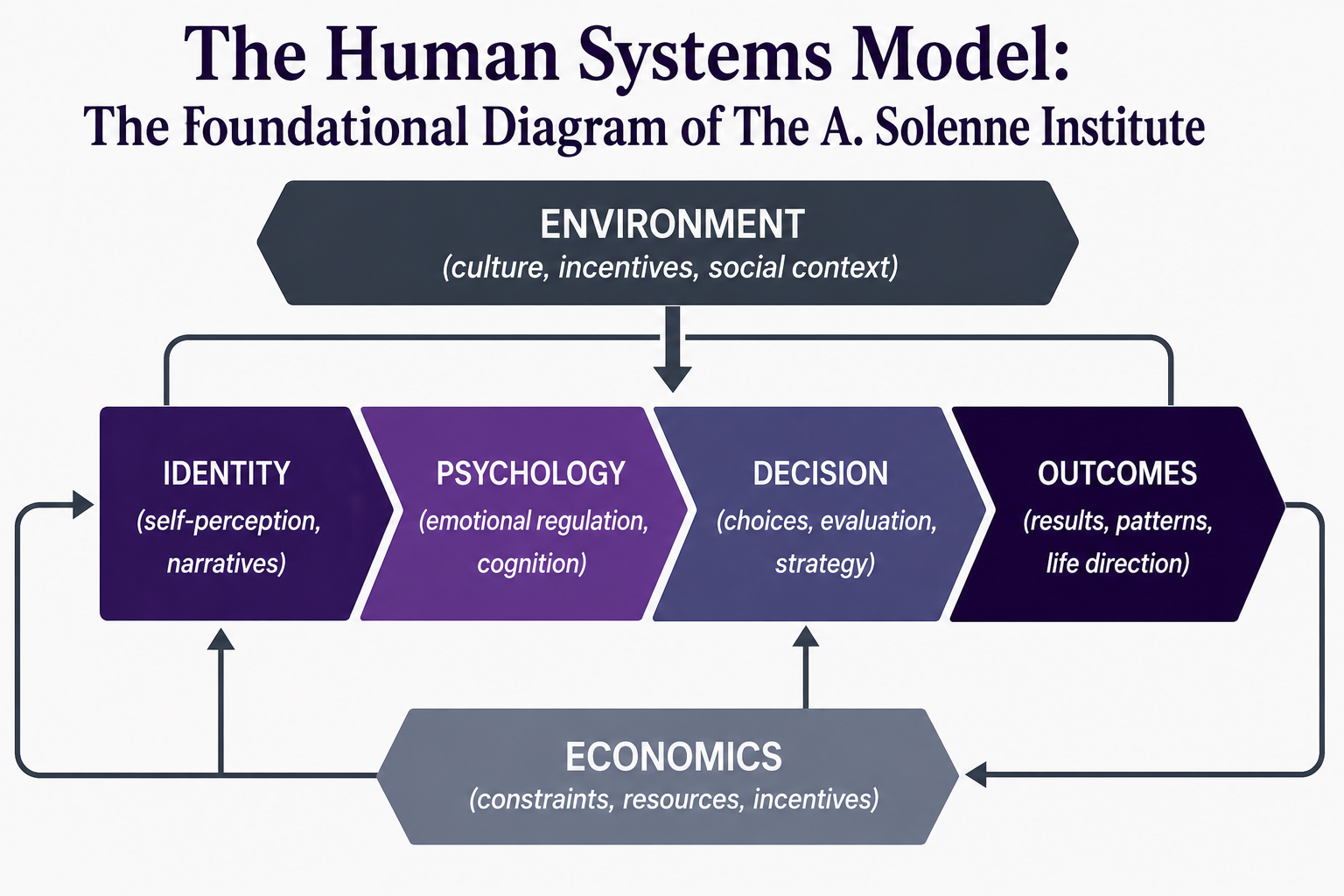
The Five Structural Forces
Identity
The self-schema through which all experience is filtered and all possibility is evaluated before any decision begins.
Psychology
The regulatory state of the nervous system and emotional system that governs behavioral range and decision quality.
Decision Architecture
The field in which choices are made, shaped by identity, regulatory state, and context before deliberation begins.
Environment
The contextual forces, social norms, physical structures, and cultural narratives that produce behavior before awareness engages.
Economics
The incentive structures, scarcity conditions, and resource constraints that shape what behavior is actually rewarded and what is not.
Why Integration Matters
Every discipline studies at least one of these forces. Psychology studies regulation and identity. Economics studies incentives and constraints. Neuroscience studies the physiological substrates of regulation. None of them, operating within their own boundaries, produces a complete account of why behavior occurs and what would change it.
The Institute's work is built on the premise that the interaction of all five forces must be examined together. A framework that accounts for only one or two of them will generate an accurate but incomplete picture, and an incomplete picture produces ineffective interventions.
The fourteen frameworks registered in The Sovereign Bureau each address a distinct domain within this model. Collectively, they form a comprehensive diagnostic and analytical structure for understanding why individuals behave as they do, and what must shift for behavior to change.
Sovereign Bureau
Founding documents of the A. Solenne Institute. These are the intellectual foundation from which all framework work proceeds.
Founding Document
Founding Charter
A declaration of purpose, scope, and intellectual commitment. Establishes the institute's mandate, mission, and research scope.
Philosophical Statement
On the Nature of Human Systems
The foundational philosophical position of the institute on human behavior, interdisciplinary method, and intellectual standard.
Manifesto
The Human Systems Manifesto
On the fragmentation of behavioral knowledge and the case for integrative structural analysis.
Foundational Document
The Ten Core Principles of Human Systems
Ten foundational observations on human behavior covering identity, regulation, decision systems, incentives, attention, pattern recognition, environment, agency, interdisciplinary method, and clarity.
Field Guide
Institute Field Guide
An introduction to the Human Systems Model, ten core principles, fourteen foundational frameworks, and applied research network.
Founding Document
A Declaration of Purpose, Scope, and Intellectual Commitment
Human behavior is not primarily the product of individual will. It is the product of structure. The forces governing how individuals form identity, regulate emotion, perceive opportunity, respond to incentives, and make decisions under uncertainty are not random. They are systemic. They operate according to patterns that can be identified, analyzed, and understood with precision if the right analytical instruments are brought to bear.
The difficulty is that the disciplines best equipped to study these forces have historically studied them in isolation. Psychology examines internal states. Economics models incentive response. Sociology analyzes structural conditions. Leadership theory addresses authority and influence. Philosophy interrogates the assumptions underlying all of them. Each discipline generates genuine insight. None of them, operating within its own boundaries, generates a complete account of how the forces they study interact to produce the outcomes that matter most in human life.
The A. Solenne Institute is an independent intellectual institute established for the study of human systems. Its foundational commitment is to the development of rigorous, interdisciplinary frameworks that explain how the structural forces governing identity, psychology, economics, and decision architecture interact to produce human behavior and its outcomes. The institute was not established to offer advice, to provide therapy, or to produce motivational content. It was established to do intellectual work.
The mission of the A. Solenne Institute is to develop structured, interdisciplinary frameworks that clarify how the systems governing identity, psychology, economics, and decision architecture interact to produce human behavior and its outcomes, and to make those frameworks available in forms that support rigorous individual and collective inquiry. This mission has three operational components: research, framework design, and documentation.
Current scope encompasses: identity formation and perceptual architecture; psychological regulation and emotional governance; decision architecture and strategic cognition; economic behavior and incentive systems; authority psychology and leadership dynamics; metacognition and reflective cognition; environmental and contextual influence; human capacity and neuroplasticity; temporal orientation and future-self architecture.
Frameworks are the primary intellectual output of the institute. A framework is a structured analytical instrument: a designed account of a specific domain of human behavior that is sufficiently precise to generate insight, sufficiently rigorous to withstand scrutiny, and sufficiently coherent to be applied consistently across different individuals and contexts.
The Sovereign Bureau is the official canonical registry of the A. Solenne Institute. It functions as the permanent intellectual archive of the institute's frameworks, principles, and foundational doctrine. Its purpose is not distribution. Its purpose is preservation, organization, and structural integrity.
Azari Solenne · Founder and Systems Architect · A. Solenne Institute
The Sovereign Bureau · A. Solenne Institute · © 2026
Philosophical Statement
On the Nature of Human Systems and the Work of This Institute
This institute is founded on a single, non-negotiable philosophical position: human behavior is structural. It is not primarily the product of character, willpower, motivation, or the presence or absence of the right information. It is the product of interacting systems that operate within and around every individual, most of them operating below the threshold of conscious awareness, most of them more powerful and more persistent than any single decision or intention brought to bear against them.
Human behavior emerges from the interaction of five structural forces: identity, psychological stability, decision architecture, economic and incentive structure, and environment and cultural context. These are not metaphors. They are operational mechanisms, functioning simultaneously, continuously, and in most cases without the conscious awareness of the individuals they govern.
The structural forces governing human behavior do not respect disciplinary boundaries. Identity is a psychological construct with philosophical dimensions and social determinants. Decision-making is a cognitive process operating within economic and environmental constraints. The interdisciplinary commitment of this institute is therefore not a methodological preference. It is a philosophical requirement.
What clarity produces is not simplicity. It produces accuracy. When an individual accurately understands the structural forces shaping their behavior, three things become possible: correct attribution, strategic engagement, and honest evaluation.
The frameworks developed by this institute are held to a single standard: accuracy. Not accessibility, not palatability. A framework that is accurate but demanding is more valuable than a framework that is comfortable but imprecise.
Azari Solenne · Founder and Systems Architect · A. Solenne Institute
The Sovereign Bureau · A. Solenne Institute · © 2026
Manifesto
Modern society produces more information about human behavior than any civilization in recorded history. Research accumulates. Libraries expand. Platforms multiply. Every year brings another framework for productivity, another model for success, another prescription for emotional well-being. The advice is everywhere. The understanding is not.
Human behavior is not primarily the product of individual choice. It is the product of system. Every decision a person makes emerges from an architecture of forces operating simultaneously, most of them below the threshold of conscious awareness: the identity structure that filters which possibilities appear worth pursuing, the regulatory state that determines the quality of cognition available in that moment, the incentive structure embedded in the environment, the cultural narratives that define what counts as success or failure before any individual evaluation begins.
When things go wrong, most analysis looks at the decision. The real question is: what produced the field in which that decision became likely?
The fragmentation of behavioral knowledge is not an incidental problem. It is a structural one. When disciplines study human behavior in isolation, their frameworks produce interventions that address one dimension of a multi-dimensional system.
The A. Solenne Institute was established to address this problem through sustained, rigorous, interdisciplinary work. Its foundational activity is framework design: the development of structured analytical models that account for the interaction of identity, psychology, economics, and decision architecture within human systems. Not frameworks that simplify. Frameworks that clarify.
This work is not therapy. It is not coaching. It is not self-help. What this work offers is something more durable than optimism. It offers precision.
Azari Solenne · Founder and Systems Architect · A. Solenne Institute
The Sovereign Bureau · A. Solenne Institute · © 2026
Foundational Document
A Foundational Framework for the Study of Human Behavior, Identity Architecture, and Decision Systems
Human behavior does not emerge from isolated acts of will. It arises from the interaction of internal architecture and external systems: the structure of identity, the state of the nervous system, the forces that shape attention, the incentives embedded in environment, and the invisible patterns that govern perception. These are not random variables. They are computable forces.
The principles contained in this document represent the intellectual spine of the institute's work. They are not prescriptions. They are observations. Each principle is independent in scope and mutually reinforcing in application. Together, they form a diagnostic lens.
Human beings do not experience reality as a neutral field of information. Identity functions as a perceptual framework that actively filters how individuals interpret opportunities, threats, relationships, and possibilities. Self-schemas, the internalized beliefs individuals hold about their own traits, capacities, and roles, operate as filters on perception and memory. Schemas that remain unexamined become invisible governors of behavior.
Research Anchors Self-schema as cognitive filter (ScienceDirect, 2003); Self-Concept Theory (Higgins, 1987; Markus, 1977); Cognitive-Experiential Self Theory (Epstein); Aaron Beck's Cognitive Triad.
Behavioral consistency is not primarily a function of willpower, intention, or motivation. It is a function of the underlying state of the psychological and physiological system from which behavior emerges. When psychological systems are dysregulated, behavior becomes reactive rather than intentional. Decision quality degrades. Access to higher-order cognition narrows. Stability is the capacity to remain responsive rather than reactive. This capacity is trainable and architecturally significant.
Research Anchors Polyvagal Theory (Porges, 1994; Frontiers in Behavioral Neuroscience, 2025); Autonomic regulation and social behavior; Emotion regulation and executive function research.
Decisions are outputs of interacting systems that include identity assumptions, emotional and physiological states, environmental incentives, social pressures, cognitive load, and habituated pattern recognition. Dual-process research demonstrates that the majority of human decisions emerge from fast, automatic, and largely unconscious processes. The felt sense of having consciously chosen is often constructed after the fact. To understand why decisions produce particular outcomes, the surrounding system must be examined.
Research Anchors Kahneman, D. (2011), Thinking, Fast and Slow; Dual Process Theory (Stanovich and West; Strack and Deutsch, 2015); Dynamic Decision-Making frameworks (Frontiers in Psychology, 2017).
Human action is reliably responsive to the incentive structures embedded in social, economic, and relational environments. When stated intentions and observed behavior diverge, the explanation is rarely a deficit of character. It is more commonly a misread of the incentive landscape. The behavior that appears irrational from the outside is often rational from within the system the individual is actually navigating.
Research Anchors Behavioral Economics and incentive structures (Thaler and Sunstein; Kahneman and Tversky); Loss Aversion Research; Prospect Theory (1979).
Attention is a finite and strategically consequential resource. Where individuals allocate cognitive and perceptual focus determines which possibilities they recognize, which threats they register, and which opportunities they develop. Attention is not simply reactive. It is generative. Managing where attention goes is one of the highest-leverage interventions available within any human system.
Research Anchors Attention-Based View of the Firm (Ocasio, 1997); Attentional Engagement and Problem-Solving (Organization Science, 2019); Dehaene's Global Neuronal Workspace Model.
Repeated behavioral outcomes are not coincidental. They are structural outputs. A system operating under consistent pressures, constraints, and incentives will produce consistent results. Identifying patterns is recognizing that structural forces produce reliable tendencies that can be mapped, analyzed, and when warranted, interrupted. This is the entry point for systemic intervention.
Research Anchors Systems theory applications in behavioral psychology; Cognitive-Behavioral pattern analysis; Habit formation research (Wood and Neal, 2007).
The context in which choices are presented exerts significant and measurable influence over how those choices are made. Social expectations, cultural narratives, physical environments, institutional structures, and economic conditions all shape the perceived costs, benefits, and availability of options. Choice architecture can shift outcomes substantially without altering the range of available options.
Research Anchors Nudge Theory (Thaler and Sunstein, 2008); Choice Architecture research; Environmental Psychology; Social determinants of behavior research.
When individuals develop genuine comprehension of the systems shaping their perceptions, decisions, and behavioral patterns, they gain qualitatively greater capacity to navigate those systems intentionally. What structural awareness provides is the difference between being subject to a system invisibly and being able to engage with it deliberately. That difference is the functional definition of expanded agency.
Research Anchors Metacognition research (Fleming, Dolan; npj Science of Learning, 2021); Structural awareness and self-regulation theory; Locus of Control research (Rotter, 1966).
Human systems operate across biological, psychological, social, economic, and philosophical dimensions simultaneously. No single academic discipline possesses the conceptual vocabulary or empirical range to account for this complexity. Significant advances have consistently emerged at disciplinary boundaries. The institute's approach is explicitly interdisciplinary by design.
Research Anchors Interdisciplinary behavioral science literature; Complexity theory in human systems (Stacey); Biopsychosocial Model (Engel, 1977); Positive Neuroscience frameworks.
Effective action requires accurate perception of the conditions in which action occurs. When individuals operate without clarity about the identity frameworks, perceptual filters, environmental incentives, and systemic forces shaping their situation, even significant effort fails to produce proportionate results. Clarity is not simplification. It is precision: the accurate understanding of which forces are operative, how they interact, and what interventions have genuine leverage.
Research Anchors Structured decision-making research; Cognitive clarity and executive function; Epictetus and Stoic frameworks on perception and action; Metacognitive clarity research.
Azari Solenne · Founder and Systems Architect · A. Solenne Institute
The Sovereign Bureau · A. Solenne Institute · © 2026
Field Guide
An Introduction to the Work of the A. Solenne Institute
Most individuals navigating the demands of modern life are not short of guidance. What is consistently absent is integration. The advice arrives from separate disciplines, designed in isolation, and rarely assembled into a coherent structure that accounts for how these forces actually operate together.
At the center of the institute's work is a foundational proposition: human outcomes are not random, and they are not solely the product of individual willpower. They emerge from the interaction of five structural forces that operate simultaneously, often invisibly, within and around every individual: Identity, Psychology, Decision Architecture, Environment, and Economics.
The institute's work is organized around ten core principles addressing: the structural mechanics of identity, the conditions governing psychological stability, the systemic nature of decision-making, the predictable influence of incentives, the strategic function of attention, the pattern-generating properties of human systems, the behavioral architecture embedded in environment, the relationship between structural awareness and personal agency, the necessity of interdisciplinary thinking, and the prerequisite role of clarity in effective action.
The institute has developed fourteen foundational frameworks addressing: Identity Architecture, Regulatory Intelligence, Decision Field Dynamics, Constraint Economics, Authority Topology, Reflective Cognition, Strategic Focus, Integrated Systems, Contextual Fields, Pattern Recognition, Sovereign Mind, Capacity Expansion, Temporal Orientation, and Applied Intelligence. Each is documented in complete form within The Sovereign Bureau.
A. Solenne Institute · The Sovereign Bureau · © 2026
Institute Research Commentary
Working papers and conceptual analyses from the Institute's interdisciplinary research program. Each note distinguishes theoretical propositions from established findings and remains open to revision as the work develops.
September 2026 · Note 005
From Knowledge to Effective Action: Applied Intelligence as a Problem of Conversion
Possessing information is not equivalent to acting effectively. Intellectual understanding may be accurate yet remain behaviorally inert, poorly timed, misapplied, or unable to survive contact with changing conditions. This Research Note frames Applied Intelligence as an area of inquiry concerned with the...
August 2026 · Note 004
Regulatory Capacity and the Conditions of Agency
Experiencing an emotion and governing behavior while experiencing that emotion are distinct human capacities. This Research Note examines emotional governance as a theoretical problem at the intersection of nervous system functioning, cognition, environment, learned behavior, resources, and agency. It prop...
July 2026 · Note 003
Beyond Isolated Variables: Toward an Architecture of Integrated Human Functioning
Human functioning is often explained by isolating a single variable: belief, motivation, emotion, habit, personality, environment, or incentive. Such variables can be analytically useful, but their isolation can obscure the mechanisms produced by their interaction. This Research Note proposes integrated hu...
June 2026 · Note 002
On the Difference Between Dysregulation and Weakness
Most people who struggle with behavioral consistency are not undisciplined. They are operating from a nervous system state that does not support the level of executive function required for the behavior they are attempting to sustain.
June 2026 · Note 001
Why People Resist Structural Explanations
There is a persistent cultural preference for personal agency explanations over structural ones. When behavior is framed as a choice, it implies it could simply be chosen differently. That framing is more comfortable than the structural account, and it is less accurate.
July 2026 · Note 003
Human functioning is often explained by isolating a single variable: belief, motivation, emotion, habit, personality, environment, or incentive. Such variables can be analytically useful, but their isolation can obscure the mechanisms produced by their interaction. This Research Note proposes integrated human functioning as an interdisciplinary object of inquiry and introduces Human Systems Architecture as a way of examining how identity, cognition, physiological and emotional state, environment, incentives, constraints, resources, and established behavioral patterns may operate together. The purpose is not to claim a complete theory of behavior. It is to define a research problem: how can human action be studied without separating the person from the interacting systems through which action becomes possible, probable, or difficult?
A single-variable explanation asks a narrow question: which factor appears most closely associated with an outcome? An integrated explanation asks a different question: what configuration of factors made this outcome more likely under these conditions? The difference is consequential. A person may possess a clear intention and still fail to act. Another may act consistently without describing a strong intention at all. If analysis stops at motivation, the first case may be interpreted as insufficient commitment and the second as evidence of discipline. Yet motivation may be only one element in a larger arrangement involving identity, cognitive load, emotional state, social expectations, material resources, time, incentives, and practiced routines.
Isolated variables are not necessarily false. They are incomplete when treated as self-sufficient causes. Identity can shape what a person recognizes as plausible. Cognition can influence how conditions are interpreted. Emotional and physiological states can alter the range of responses available in a given moment. Environments can make some actions easy, costly, visible, or socially reinforced. Economic conditions can expand or restrict real options. Repeated behavior can create patterns that subsequently influence perception and expectation. Each dimension may be relevant, but the outcome may arise from their organization rather than from any one dimension alone.
This suggests a distinction between identifying components and explaining a system. A list of factors describes what is present. A systems account investigates relations: which factors constrain others, which amplify one another, which compensate for weakness elsewhere, and which become decisive only under particular conditions. Human functioning may therefore be better understood as configurational. The same factor may have different effects depending on the surrounding arrangement.
Human Systems Architecture is proposed here as the study of the structures and interactions that organize human functioning across psychological, behavioral, social, environmental, and economic domains. The term architecture does not imply that people are machines or that behavior can be reduced to a fixed design. It emphasizes organization. An architecture establishes relationships among components, channels pressures, creates dependencies, and makes some pathways more available than others. It can be stable in certain respects while remaining adaptive in others.
Within this frame, identity is not merely a description a person gives of the self. It may operate as a set of organizing assumptions about belonging, capacity, obligation, risk, and possibility. Cognition is not treated as detached reasoning alone; it includes interpretation, attention, memory, judgment, and the construction of meaning under limited conditions. Emotional state is neither noise nor an instruction that must be obeyed. It is part of the information and activation environment in which decisions occur. Material and social environments are not external background. They participate in the production of available choices, perceived costs, and expected consequences.
Incentives and constraints require equally careful treatment. An incentive has no uniform effect independent of the person interpreting it. A reward that encourages one behavior may be irrelevant, threatening, or inaccessible in another context. A constraint may be objective, perceived, institutional, relational, financial, or temporal. Resources may include money and material support, but also time, information, social access, physical capacity, and opportunities for recovery or revision. The analytical task is to determine how these conditions combine, not to assume that one category consistently dominates.
An integrated account must also consider feedback. Behavior changes conditions, and changed conditions influence subsequent behavior. A decision can alter available resources, relationships, expectations, and self-interpretation. Repetition may make an action more familiar, but it may also strengthen an identity claim or change the environment so that the action becomes easier to repeat. Conversely, an unsuccessful attempt may increase perceived constraint, narrow attention, or reorganize expectations about future action.
These feedback processes can produce patterned outcomes without requiring a single controlling cause. Consider a person who repeatedly delays a consequential decision. A psychological account might examine avoidance. A cognitive account might examine uncertainty or overload. A sociological account might examine role expectations. A decision-science account might examine how options are framed. An economic account might examine resource exposure and downside risk. A physiological account might examine the person’s state under pressure. Each perspective could contribute. The central research question is how these explanations relate within the same case.
The interaction may be recursive. Perceived risk may intensify emotional activation. Emotional activation may narrow interpretation. Narrowed interpretation may make constraints appear more absolute. Delayed action may preserve short-term stability while increasing long-term cost. That increased cost may then intensify the perceived risk of acting. No single variable fully explains the resulting pattern because the pattern is maintained by a loop.
This example is conceptual, not an empirical finding. It illustrates why interdisciplinary analysis may reveal mechanisms missed by explanations that assign an outcome to one trait or state. It also shows why integrated analysis must remain disciplined. Calling something “systemic” is not an explanation unless the relevant components, relationships, and feedback processes can be specified.
A systems approach need not eliminate agency. It can make the conditions of agency more precise. Agency is often discussed as though it were either fully present or absent. A more useful proposition is that agency may vary in its practical expression according to regulatory capacity, information quality, perceived options, material resources, social position, learned patterns, and the consequences attached to action. A person can remain an agent while operating within conditions that make some actions far more costly or difficult than others.
This view avoids two symmetrical errors. The first is to treat every outcome as the direct expression of personal choice, overlooking the structures that organize which choices are available and sustainable. The second is to treat structure as total determination, overlooking interpretation, revision, learning, resistance, and deliberate action. Human Systems Architecture places the research problem in the relation between these positions: how people act within systems, how systems act through people, and how both may change over time.
Integrated human functioning can support several lines of investigation. Researchers might examine when identity assumptions override explicit knowledge; how physiological state changes the use of available information; how incentives interact with perceived legitimacy or belonging; how scarcity affects attention and temporal judgment; or how environmental design supports one behavioral pattern while undermining another. The purpose would not be to assemble every possible variable into an unmanageable model. It would be to identify the smallest adequate system for explaining the outcome under study.
That standard matters. Interdisciplinary work should not become indiscriminate accumulation. It requires clear concepts, explicit levels of analysis, and careful distinctions between theoretical propositions, observed associations, and causal claims. Human Systems Architecture is offered as an organizing research orientation: a commitment to investigate interaction before assigning isolated cause, to examine context before interpreting character, and to treat human functioning as an integrated process rather than a collection of disconnected parts.
The proposition is straightforward. Human outcomes may become more intelligible when the unit of analysis expands from the isolated variable to the organized system. The work ahead is to determine where that proposition holds, how its mechanisms can be specified, and what forms of inquiry are capable of testing it.
Azari Solenne · A. Solenne Institute · © 2026
August 2026 · Note 004
Experiencing an emotion and governing behavior while experiencing that emotion are distinct human capacities. This Research Note examines emotional governance as a theoretical problem at the intersection of nervous system functioning, cognition, environment, learned behavior, resources, and agency. It proposes that decision capacity is not adequately described by the presence or intensity of emotion alone. The relevant question is whether a person can maintain sufficient access to interpretation, evaluation, inhibition, and purposeful action under the conditions in which a decision must be made. The discussion is conceptual and does not offer clinical assessment or mental-health advice.
Emotions are part of human functioning. They may register significance, orient attention, prepare action, communicate needs, or reflect a person’s interpretation of conditions. Yet the fact that an emotion is present does not determine what behavior must follow. Fear does not require retreat in every instance. Anger does not require aggression. Grief does not eliminate all judgment. Excitement does not guarantee that a risk is acceptable. Between emotional experience and behavioral execution lies a set of capacities that can be described broadly as regulatory.
Regulation is sometimes misrepresented as suppression, detachment, or the absence of strong feeling. That framing is too narrow for the present inquiry. Emotional governance concerns the ability to remain in a workable relationship with an emotional state while preserving enough behavioral range to choose, delay, revise, or redirect action. The governing capacity is not proved by appearing calm, and visible intensity does not by itself establish incapacity. The relevant issue is functional: what forms of perception, judgment, and action remain available while the state is occurring?
This distinction protects analysis from a common conceptual error. If emotion is treated as the cause of behavior, the intervening processes disappear. If regulation is treated as willpower, the conditions that support or constrain those processes disappear. A systems account asks what happens between state and action.
The Institute treats the relationship between nervous system state and decision-making as an area for interdisciplinary investigation, not as a basis for diagnosing individuals. A physiological state may influence arousal, attention, urgency, bodily readiness, and the salience of potential threats or rewards. Cognitive interpretation may then organize those signals into meaning: this is dangerous, this is unfair, this must be resolved immediately, or this can be tolerated. The resulting decision environment is simultaneously bodily, interpretive, and contextual.
It is therefore useful to distinguish information from availability. A person may possess relevant knowledge without being able to use it effectively in a particular state. The issue may not be memory in the simple sense, but access to comparison, temporal perspective, inhibition, or flexible interpretation under pressure. A person who can describe an effective course of action in retrospect may have experienced a narrower set of usable options in the moment.
This does not establish that physiology unilaterally controls behavior. It proposes that state can change the conditions under which cognition operates. The direction and magnitude of that influence are empirical questions. They may vary across people, situations, histories, and available supports. A responsible model must leave room for this variation rather than converting a plausible relationship into a universal rule.
Physiological activation does not occur in an interpretive vacuum. People assess what a situation means, what is at stake, what others may do, and what consequences are likely to follow. Those interpretations are shaped by immediate evidence, prior learning, identity, social position, and the environment in which the event occurs. Two situations that appear similar to an outside observer may present different decision architectures to the people involved.
Environmental conditions can alter regulatory demands. Time pressure, surveillance, social exposure, ambiguity, conflict, financial risk, or lack of privacy may make reflective action more difficult. Stable support, clear information, sufficient time, and reversible options may expand it. These conditions do not mechanically produce a decision. They change the field within which a decision is made.
Perceived constraints also matter, even when they do not perfectly match external conditions. A person acts on the option set they can recognize, not on every option that might be visible to an outside analyst. At the same time, perception should not be treated as the entire explanation. Some constraints are material and institutional. A framework that focuses only on interpretation risks redescribing genuine limits as failures of mindset. Regulatory analysis must therefore examine both perceived and actual conditions, and the relation between them.
Behavior under emotion is partly organized by learning. Repeated responses can become familiar, rapidly available, and socially reinforced. A person may have learned that withdrawal reduces immediate conflict, that escalation secures attention, that compliance preserves belonging, or that delay prevents irreversible action. These patterns may have been adaptive in one environment and costly in another. Their persistence does not prove that they are fixed traits. It indicates that behavior has a history.
From this perspective, regulatory capacity includes behavioral range. The larger the range of responses that remain available under pressure, the less likely one established pattern is to operate as the only apparent option. Range may involve the ability to pause, seek information, tolerate uncertainty, communicate a boundary, leave a situation, reconsider a first interpretation, or defer a consequential choice. Which responses are possible depends partly on skill, but also on safety, resources, authority, and context.
The theoretical implication is that agency cannot be evaluated solely by asking whether a person made a choice. It requires examining the quality and range of choices accessible at the time. A formally available option may not be practically available if its cost is prohibitive, its consequences are unknown, or the person lacks the material support needed to sustain it.
Regulatory discourse often centers on internal technique. A human-systems approach broadens the analysis to include resources. Time can be a regulatory resource because it allows activation to change and additional information to emerge. Money can be a regulatory resource because it makes exit, delay, or professional support possible. Trusted relationships can be resources because they provide perspective, accountability, or protection. Institutional procedures can either support regulation through clarity and due process or undermine it through uncertainty and arbitrary pressure.
This does not mean regulation is external to the person. It means that internal capacity is exercised within a resource environment. The same individual may display different decision capacity when rested rather than depleted, informed rather than uncertain, supported rather than isolated, or secure rather than exposed to immediate loss. A complete account should investigate these differences before attributing the outcome to character.
Emotional governance can be framed as the preservation of purposive agency under affective pressure. The word governance is used deliberately. Governance does not eliminate forces; it coordinates them. An institution governs competing demands through structures, thresholds, procedures, and feedback. By analogy, emotional governance concerns how a person relates feeling, interpretation, values, consequences, and action without assuming that any one element should dominate automatically.
This analogy has limits. It is a conceptual device, not a claim that human experience follows an administrative model. Its value lies in shifting attention from whether an emotion should exist to how action is organized while it exists. The research questions then become more precise. Under what conditions does intense emotion narrow behavioral range? What restores or preserves access to deliberation? When is rapid action adaptive? How do environmental demands and resource constraints change the answer? How do learned patterns interact with immediate state?
These are questions for empirical and theoretical work. The present note does not resolve them. It proposes that the relationship between regulation and agency is conditional and systemic. Decision capacity emerges from the interaction of physiological state, interpretation, environment, perceived and actual constraints, learned behavior, and available resources.
The central distinction remains: feeling an emotion is not the same as being governed by it, and governing behavior is not the same as erasing feeling. A serious account of agency must be able to hold both facts at once.
Azari Solenne · A. Solenne Institute · © 2026
September 2026 · Note 005
Possessing information is not equivalent to acting effectively. Intellectual understanding may be accurate yet remain behaviorally inert, poorly timed, misapplied, or unable to survive contact with changing conditions. This Research Note frames Applied Intelligence as an area of inquiry concerned with the conversion of knowledge into contextually effective action. It examines possible relationships among information, interpretation, judgment, decision architecture, constraint recognition, execution, adaptability, and feedback. The aim is not to present a proprietary method or to claim a settled theory. It is to define the conversion problem and identify questions that interdisciplinary research must address.
Modern institutions produce and distribute extraordinary quantities of information. Instructions, analyses, models, and expert commentary are widely available across many domains. Yet access to knowledge does not reliably produce corresponding action. People may know what a situation requires and still act otherwise. Organizations may possess accurate reports and continue established patterns. A technically correct plan may fail when implemented in a context it did not adequately represent.
The familiar explanation is that people do not execute what they know. That statement describes the gap but does not explain it. It treats execution as a final switch that is either activated or not. A more rigorous approach asks what must occur for knowledge to become action. Information must be noticed, interpreted, judged relevant, connected to a decision, translated into behavior, sustained under actual constraints, and revised in response to results. Failure at any point can separate understanding from effectiveness.
This suggests that the knowledge-action gap is not one gap. It is a sequence of conversion problems. Different disciplines illuminate different parts of that sequence: cognitive science can examine attention and representation; psychology can examine belief, identity, emotion, and habit; decision science can examine evaluation and choice; sociology can examine roles and institutional conditions; economics can examine incentives and constraints; philosophy can examine judgment, responsibility, and practical reason; systems thinking can examine feedback and interaction across levels.
Applied Intelligence is proposed as a field of inquiry at these intersections.
Information has no behavioral consequence until it is interpreted. Interpretation determines what the information is about, whether it matters, how certain it appears, and what it implies for action. The same data may be understood as a warning, an opportunity, an anomaly, or irrelevant noise. These interpretations are not produced by information alone. They are shaped by prior models, identity commitments, institutional incentives, emotional state, and the decision-maker’s understanding of context.
This creates the first conversion problem: accurate information can enter an inaccurate interpretive frame. A person may understand the literal content of a recommendation while misunderstanding the conditions under which it applies. An organization may collect evidence that challenges its strategy but classify the evidence as a temporary exception. Knowledge is present, yet its significance is neutralized by the architecture through which it is received.
Applied Intelligence therefore concerns more than acquisition. It asks whether the interpretive model is adequate to the environment. This is partly an epistemic question—what is known and how well is it justified—and partly a practical one—what does this knowledge require here?
Even an adequate interpretation does not specify a decision automatically. Judgment is required to compare objectives, risks, time horizons, obligations, and uncertainties. General principles must be related to particular conditions. Competing goods may need to be ordered. An action that is effective by one measure may be unacceptable by another.
Judgment differs from rule recall. A rule can reduce complexity, but it can also conceal relevant variation. “Act quickly” may be useful in one environment and reckless in another. “Gather more information” may improve a high-stakes decision or become a mechanism for indefinite delay. Applied Intelligence includes the capacity to determine which distinctions matter and when a familiar rule no longer fits.
This is why intellectual sophistication alone is not a guarantee of effective action. A person can generate many interpretations without selecting among them. Analytical range may improve judgment, but it may also increase indecision if priorities and thresholds are undefined. Conversely, decisive action can occur without adequate judgment when urgency, confidence, or institutional power substitutes for careful evaluation.
The research problem is not to choose between analysis and action. It is to understand the architecture that connects them.
Knowledge becomes actionable within a decision structure. That structure includes the available options, the order in which they are encountered, the criteria used to compare them, the time allowed, the consequences of delay, and the authority to act. It also includes what is absent: options that are invisible, unavailable, or excluded before evaluation begins.
An individual may know what would be effective but lack authority, resources, or a viable path of execution. A team may agree on a goal while operating under incentives that reward contrary behavior. An institution may request innovation while penalizing the uncertainty that innovation requires. In such cases, the problem is not simply a deficit of knowledge. The surrounding decision architecture prevents or distorts conversion.
Constraint recognition is therefore a central component of Applied Intelligence. Effective action requires distinguishing between constraints that must be accepted, constraints that can be negotiated, constraints produced by current design, and constraints that are only assumed. Underestimating constraint produces unrealistic plans. Overestimating it produces unnecessary surrender. Both errors weaken execution because action is calibrated to the wrong environment.
Execution is often described as the application of a prior decision. In practice, execution generates new information. Conditions change. Unanticipated dependencies appear. Other people respond. Costs become clearer. Initial assumptions are tested. Action is not merely the end of cognition; it is a method through which the environment answers back.
This makes adaptability part of intelligence rather than an admission that the original plan failed. A plan can be thoughtfully designed and still require revision because no representation contains the full context in advance. The relevant capacity is not rigid adherence or constant improvisation. It is disciplined responsiveness: preserving the governing purpose of an action while changing its form when evidence warrants.
Behavioral execution also depends on practical sequencing. A valid objective may fail because the first action is too large, because dependencies are unresolved, because responsibility is diffuse, or because feedback arrives too late to guide correction. These are architectural problems. They concern how action is organized across time, resources, and people.
Applied Intelligence asks which structures make effective execution more likely without reducing human judgment to procedure. The question is not whether a universal sequence exists. It is how decision-makers can create enough structure to act while preserving enough flexibility to learn.
Action without feedback cannot reliably become adaptive. Feedback indicates whether the interpretation, judgment, and execution were adequate to the context. Yet feedback is not self-explanatory. It must also be noticed and interpreted. A favorable short-term result may conceal long-term cost. An unfavorable result may reflect poor execution, an incorrect model, uncontrollable variation, or a worthwhile action whose benefits have not yet appeared.
The conversion process is therefore cyclical. Knowledge informs interpretation; interpretation informs judgment; judgment organizes decision; decision directs execution; execution produces feedback; feedback revises knowledge. Breaks can occur anywhere in the cycle. Institutions may collect feedback and suppress it. Individuals may receive feedback and integrate it into an identity judgment rather than a model revision. Metrics may reward what is measurable while obscuring what matters.
A mature account of Applied Intelligence must study the governance of feedback: who receives it, what counts as evidence, how quickly revision can occur, and which commitments are protected from reconsideration. These questions link cognition to power and learning to institutional design.
Applied Intelligence is not proposed as another name for productivity, expertise, or practical advice. It is the study of how knowledge is converted into action that is effective relative to a defined purpose and actual context. That definition contains necessary limits. Effectiveness cannot be evaluated without specifying the objective. Context cannot be treated as decoration. And action cannot be called intelligent solely because it succeeds in the short term; ethical, institutional, and long-term consequences remain part of judgment.
Future inquiry might examine how identity affects the acceptance of corrective information; how emotional and physiological states alter judgment under pressure; how resource scarcity changes option recognition; how incentives separate declared goals from rewarded behavior; how expertise supports or obstructs adaptation; and how feedback systems enable learning across individual and institutional levels. Each question requires conceptual precision and, where claims concern observable relationships, empirical investigation.
The working proposition is that effective action depends on a chain of conversions rather than on knowledge alone. Information must become interpretation. Interpretation must become judgment. Judgment must enter a viable decision architecture. Decision must become executable behavior. Behavior must remain responsive to feedback. Applied Intelligence names the inquiry into that chain—and into the conditions under which it holds, breaks, or can be strengthened.
Azari Solenne · A. Solenne Institute · © 2026
June 2026 · Note 001
There is a persistent cultural preference for personal agency explanations over structural ones. When behavior is framed as a choice, it implies it could simply be chosen differently. That framing is more comfortable than the structural account, and it is considerably less accurate.
The structural account does not diminish agency. It relocates it. If your behavior is governed by systems operating largely outside conscious awareness, changing that behavior requires understanding and engaging those systems. That is harder than deciding to do better. It is also the only approach that produces durable results.
The resistance to structural explanations is itself a structural phenomenon. Identity investment in personal agency as the primary frame for understanding behavior makes structural analysis feel like an attack on self-determination. It is not. It is a more precise account of where self-determination actually operates and how it can be meaningfully exercised.
This is why the first task is not behavioral change. It is conceptual reorientation. Until someone can hold a structural view of their own behavior without experiencing it as a threat to their sense of agency, intervention at the level of structure is unlikely to land.
Azari Solenne · A. Solenne Institute · © 2026
June 2026 · Note 002
Most people who struggle with behavioral consistency are not undisciplined. They are operating from a nervous system state that does not support the level of executive function required for the behavior they are attempting to sustain. This is not a minor distinction. It changes the diagnosis entirely, and therefore changes what the intervention should be.
Dysregulation is a physiological condition, not a character assessment. When the autonomic nervous system is in a state of chronic threat response, access to the prefrontal cortex, the architecture responsible for planning, impulse regulation, and deliberate action, is structurally compromised. You cannot discipline your way out of a nervous system state. You can only regulate your way through it.
This is why behavioral interventions that rely primarily on motivation and willpower produce temporary results. They are operating on the executive system at exactly the moment when that system's capacity is most constrained. The appropriate entry point is regulation, not discipline. Stability first. Then execution.
The conflation of dysregulation with weakness is one of the most consequential errors in popular frameworks for behavioral change. It misdirects effort, generates shame where there should be diagnosis, and ensures that the structural conditions producing the problem remain completely unaddressed.
Azari Solenne · A. Solenne Institute · © 2026
The Institute
The A. Solenne Institute is an independent interdisciplinary research body dedicated to the study of human systems and the development of original analytical frameworks. Its work examines how identity, cognition, regulation, decision architecture, environment, social conditions, and economics interact to shape human functioning.
The Institute produces doctrine, research commentary, and structured models intended for rigorous study and defined forms of application. Its central concern is not isolated traits, but the architecture through which multiple forces become patterned outcomes.
The Institute is not a clinical practice, coaching service, motivational platform, or substitute for medical, psychological, legal, or financial advice.
Its work is developed as an independent body of thought rather than as trend-responsive content. Access and licensing are structured according to the intended use, scope, and responsibility attached to each framework.
Research
The Institute studies human functioning as an interdisciplinary problem: one that cannot be adequately explained by isolated psychological variables or by any single disciplinary tradition.
Its inquiry draws from psychology, neuroscience, sociology, behavioral science, cognitive science, decision science, behavioral economics, and philosophy. Research considers how cognition, identity, emotional regulation, nervous system functioning, social context, incentives, material resources, environmental conditions, and learned patterns of behavior interact to shape judgment, agency, and action.
This work emphasizes theory development, interdisciplinary analysis, and applied research into human systems. Particular attention is given to the relationship between psychological, behavioral, social, environmental, and economic structures; to the philosophical questions of autonomy, responsibility, agency, and self-governance; and to applied intelligence as the study of how knowledge is converted into contextually effective action.
Research Domains
The Institute’s research is organized around the study of integrated human functioning.
The structures and interactions that organize human functioning across psychological, behavioral, environmental, and economic domains.
How identity is formed, maintained, revised, and translated into patterns of agency, behavior, and self-direction.
The relationship between nervous system states, emotional regulation, behavioral capacity, and human decision-making.
How people perceive, evaluate, choose, adapt, and convert knowledge into effective action.
The psychological and cognitive mechanisms underlying patterns of thought, behavior, interpretation, and response.
How incentives, resources, constraints, and economic environments interact with individual behavior and opportunity.
The philosophical foundations of autonomy, responsibility, self-governance, and human possibility.
Canonical Registry
The permanent intellectual archive of the A. Solenne Institute.
The Sovereign Bureau is not content. It is not commentary. It is final form knowledge: doctrines, frameworks, and models admitted only when fully stabilized and structurally complete. Archive entries are published when fully formed. Not before.
Applied Work
The institute's frameworks are applied through domain platforms. Each platform draws its conceptual foundation from The Sovereign Bureau.
Self-Mastery · Active
Distinct Character
Psychological governance, nervous system stability, identity structure, and disciplined thinking applied to individual behavior. The primary applied platform of the A. Solenne Institute.
distinctcharacter.com
Systems Architect
Founder & Systems Architect
A. Solenne Institute
The Sovereign Bureau
Azari Solenne is the founder and systems architect of the A. Solenne Institute, an independent research institute dedicated to the interdisciplinary study of human systems. Her work sits at the intersection of behavioral psychology, cognitive neuroscience, philosophy, economics, and systems theory. She draws from each without being confined by any single one.
Her intellectual project begins from a structural premise: human behavior is not random and is not primarily determined by effort or intention. It is governed by architecture. The systems of identity, regulation, decision-making, environment, and economics that operate within and around each individual produce outcomes with a consistency that only becomes visible when examined at the structural level.
Solenne works as a framework designer rather than a practitioner, coach, or therapist. Her output is intellectual: the development of precise analytical models that clarify how human systems function, and the documentation of those models in forms that can be studied, applied, and built upon. This work is archived through The Sovereign Bureau and distributed through domain platforms that translate the research into applied educational material.
She holds a Bachelor of Arts in Psychology and is completing an MBA.
Her research spans identity formation, emotional governance, nervous system regulation, decision architecture, economic incentive structures, and the philosophical foundations of self-governance. These are not separate interests. They are dimensions of a single inquiry into how human beings function as integrated systems.
Access & Inquiry
Framework licensing, institutional access, research correspondence, speaking requests, and advisory inquiries are handled through a structured review process. Please identify the work, license, or institutional context relevant to your request.