Foundational Model
The Human Systems Model
This institute studies how identity, psychology, economics, decision architecture, and environment interact to produce human behavior. No single force operates in isolation. Every behavioral outcome is the product of all five, operating simultaneously.
The model below maps the structural relationship between these forces. It is the conceptual foundation from which all fourteen frameworks of the Institute are derived.
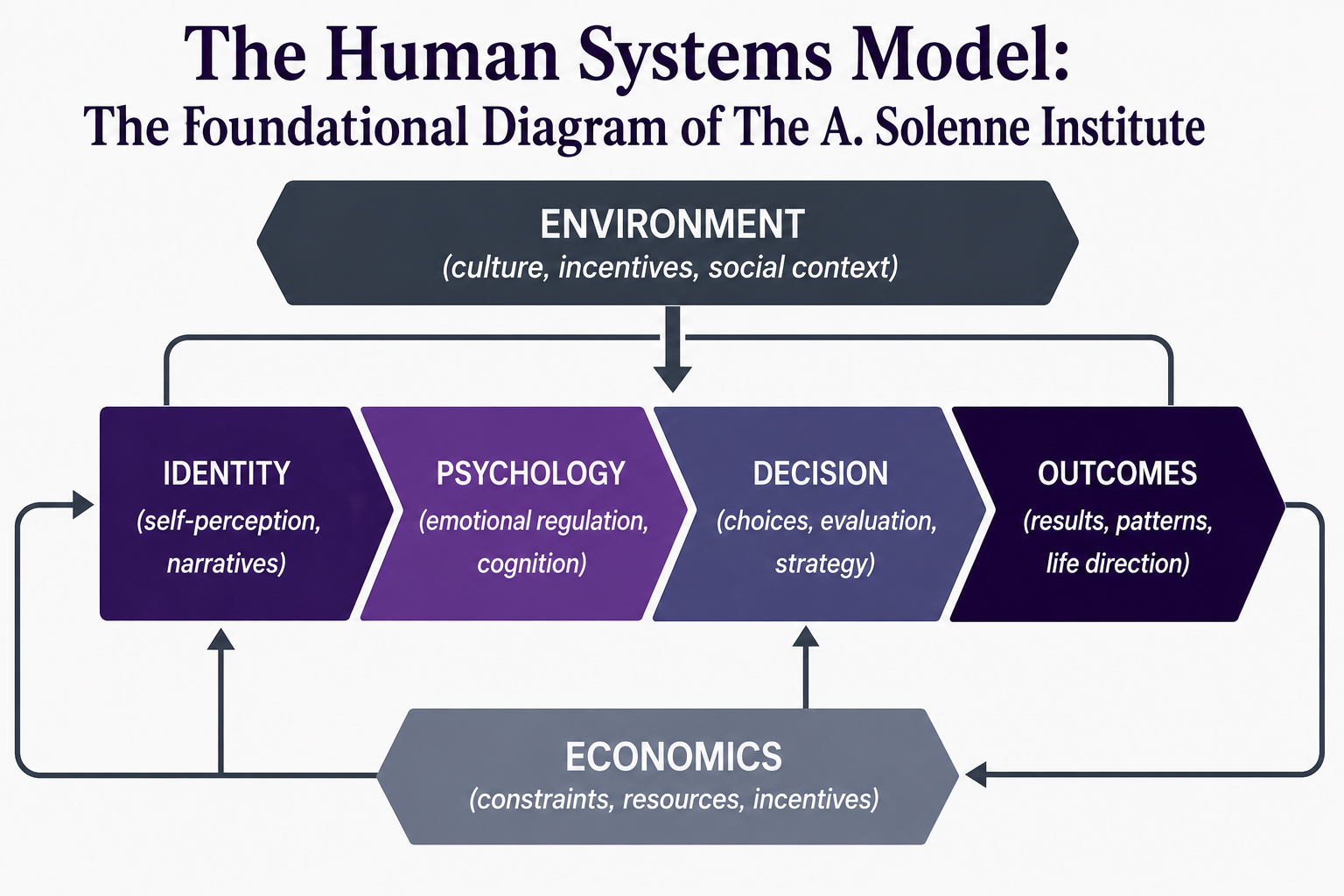
The Five Structural Forces
01
Identity
The self-schema through which all experience is filtered and all possibility is evaluated before any decision begins.
02
Psychology
The regulatory state of the nervous system and emotional system that governs behavioral range and decision quality.
03
Decision Architecture
The field in which choices are made, shaped by identity, regulatory state, and context before deliberation begins.
04
Environment
The contextual forces, social norms, physical structures, and cultural narratives that produce behavior before awareness engages.
05
Economics
The incentive structures, scarcity conditions, and resource constraints that shape what behavior is actually rewarded and what is not.
Why Integration Matters
Every discipline studies at least one of these forces. Psychology studies regulation and identity. Economics studies incentives and constraints. Neuroscience studies the physiological substrates of regulation. None of them, operating within their own boundaries, produces a complete account of why behavior occurs and what would change it.
The Institute's work is built on the premise that the interaction of all five forces must be examined together. A framework that accounts for only one or two of them will generate an accurate but incomplete picture, and an incomplete picture produces ineffective interventions.
The fourteen frameworks registered in The Sovereign Bureau each address a distinct domain within this model. Collectively, they form a comprehensive diagnostic and analytical structure for understanding why individuals behave as they do, and what must shift for behavior to change.